Knowing the size of a garden planter is useful for more than just comparing pots. Accurate measurements can help you choose the right saucer, estimate how much potting mix you need, determine whether a nursery pot will fit inside a decorative container, and compare planter sizes when shopping.
Measuring a planter can be straightforward when it is empty and rectangular, but round, tapered, unusually shaped, or already-planted containers require a little more care. The measurements you need also depend on what you are trying to determine.
Which planter measurement do you need?
- For a saucer: Measure the outside width or diameter at the bottom of the planter.
- For a cover pot: Measure the inside width and inside height.
- For potting mix: Measure the inside dimensions of the usable planting area.
- For a round planter: Measure the inside diameter and depth.
- For a rectangular planter: Measure inside length, width, and depth.
How To Measure A Planter For A Saucer
When choosing a saucer, you usually need the outside diameter or width at the bottom of the planter. This is the portion of the pot that will actually sit inside the saucer.
If the planter is empty, turn it upside down on a level surface. Place a tape measure across the widest part of the bottom and measure from one outside edge to the opposite outside edge.
For a round planter, make sure the tape crosses the center. If you are not sure where the widest point is, move the tape slightly until you find the largest measurement.
Measuring A Planter That Is Already Full
Many planters are wider at the top and narrower at the bottom, which makes the base difficult to measure once the planter is filled.
One simple method is to place the planter on a flat surface and mark the position of both outside edges of the base using chalk or removable masking tape. Move the planter, then measure the distance between the marks.
On a deck or other surface with gaps, make sure the marks fall on solid boards so you have accurate reference points.
What Size Saucer Should You Buy?
The saucer should be slightly wider than the base of the planter so the pot sits comfortably inside without being wedged against the edges.
Adding roughly 1 to 2 inches to the measured base diameter is a useful starting point, but saucer designs vary. Check the manufacturer's interior dimensions whenever possible, especially for planters with unusually shaped bases.
How To Measure For A Cover Pot
Decorative planters are often used as cover pots or cachepots, with a nursery pot placed inside rather than planting directly into the decorative container.
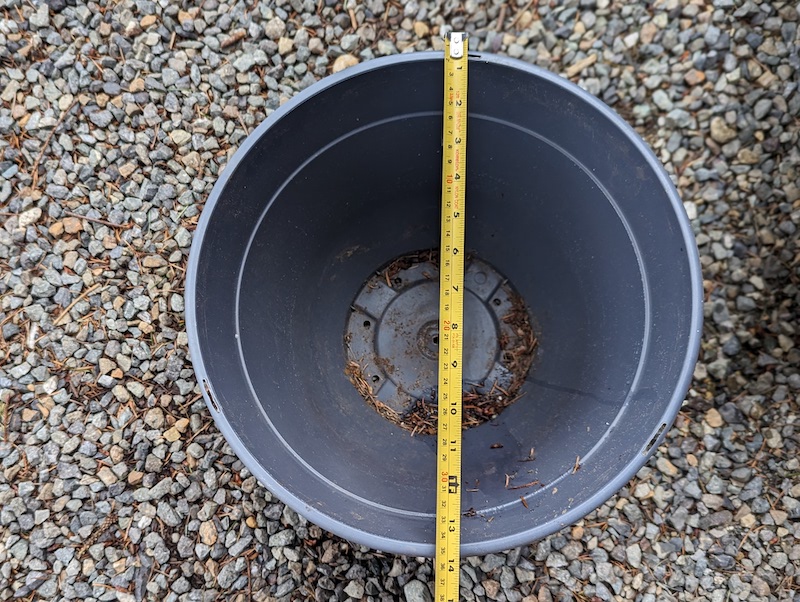
For this use, measure the inside diameter or width of the decorative pot at its narrowest point, along with the usable inside height.
Keep in mind that a planter may taper inward near the bottom. Even if the opening is wide enough, a nursery pot may not slide all the way down if the interior becomes narrower.
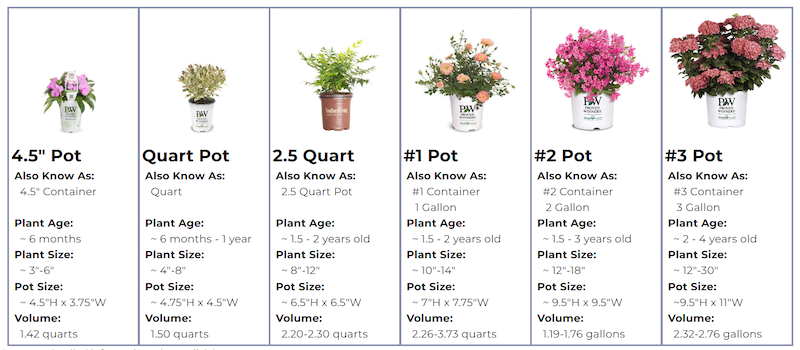
Common Plant Addicts nursery pot sizes
Approximately 4.5" tall × 3.75" wide
Approximately 4.75" tall × 4.5" wide
Approximately 6.5" tall × 6.5" wide
Approximately 7" tall × 7.75" wide
Approximately 9.5" tall × 9.5" wide
Approximately 9.5" tall × 11" wide
How To Calculate How Much Potting Mix A Planter Holds
Measuring the inside of an empty planter gives the most accurate estimate of how much potting mix it can hold. Exterior measurements include the thickness of the container walls and will slightly overestimate capacity.
You also do not normally fill a planter completely to the rim. Leaving approximately an inch of space at the top makes watering easier, so the actual amount of potting mix used may be somewhat less than the calculated maximum volume.
Important: The formulas below work best for planters with relatively straight sides. Tapered, curved, or irregularly shaped containers require an estimate or a more specialized volume formula.
Square Or Rectangular Planters
Measure the inside length, inside width, and usable depth.
If the measurements are in feet:
Length × Width × Depth = Cubic Feet
For example, a planter that measures 2 feet long × 1 foot wide × 1 foot deep has a maximum volume of:
2 × 1 × 1 = 2 cubic feet
If you measure in inches, multiply the three dimensions first and then divide by 1,728, because one cubic foot contains 1,728 cubic inches.
(Length in inches × Width in inches × Depth in inches) ÷ 1,728 = Cubic Feet
Round Planters
A round planter with straight sides is approximately a cylinder. To calculate its volume, you need the inside diameter and usable depth.
First, divide the diameter by 2 to find the radius.
Radius = Diameter ÷ 2
Volume = π × Radius² × Depth
If all measurements are in feet, the result will be in cubic feet.
Example: 24-inch-wide round planter
Inside diameter: 24 inches = 2 feet
Radius: 2 ÷ 2 = 1 foot
Depth: 18 inches = 1.5 feet
Volume = 3.14 × 1 × 1 × 1.5 = about 4.7 cubic feet
Tapered Round Planters
Many decorative pots are wider at the top than at the bottom. Treating these as full cylinders using only the top diameter can noticeably overestimate how much soil they hold.
For a quick estimate, measure the inside diameter near the top and bottom and use an average diameter:
Average Diameter ≈ (Top Diameter + Bottom Diameter) ÷ 2
Then use that average diameter in the round-planter formula above. This is still an estimate, but it is usually more useful than calculating volume from the widest point alone.
Converting Cubic Feet To Gallons
Potting mix is often sold in cubic feet, while some planters are described by gallons. If you need to compare the two:
1 Cubic Foot
≈ 7.48 U.S. gallons
1 U.S. Gallon
≈ 0.134 cubic feet
Remember that these calculations estimate the container's interior volume. The actual amount of potting mix needed can be lower because of the plant's root ball, the space left below the rim, planter inserts, or the shape of the container.
Planter Measurements At A Glance
Diameter
The straight-line distance across a round planter through its center.
Radius
Half of the diameter of a round planter.
Depth
The usable inside distance from the bottom to the desired soil level.
Capacity
The volume inside the planter, usually expressed in cubic feet or gallons.
Choosing a new planter? Once you know the measurements you need, see our guide to choosing planter sizes for help matching container size to your plants.
Sources
- Plant Addicts — Container Gardening Resources
- University of Minnesota Extension — Container Gardening Resources
- Illinois Extension — Container Gardening Resources

Written By
Garden Writer at Plant Addicts
Published May 16, 2023 | Updated October 2, 2026