Arborvitae (Thuja) are evergreen shrubs and trees that are commonly grown as a privacy screen, windbreak, garden border or just to add four seasons of interest in the landscape. These bushes are relatively easy to care for. However, one common problem gardeners run into is bagworms.
Bagworms can strip arborvitae of foliage quickly, and the damage is often permanent. This guide covers how to spot bagworms, when to treat them, how to remove them, and what to expect as your arborvitae recovers.
The quick answer: Pick off and destroy bagworm bags from fall through early spring, before the eggs inside hatch in May or early June. If there are too many to pick by hand, spray Bacillus thuringiensis (Bt) in June while the caterpillars are small. For larger caterpillars after mid-July, use an insecticide labeled for bagworms. Scratch-test brown branches and prune out any that are dead.
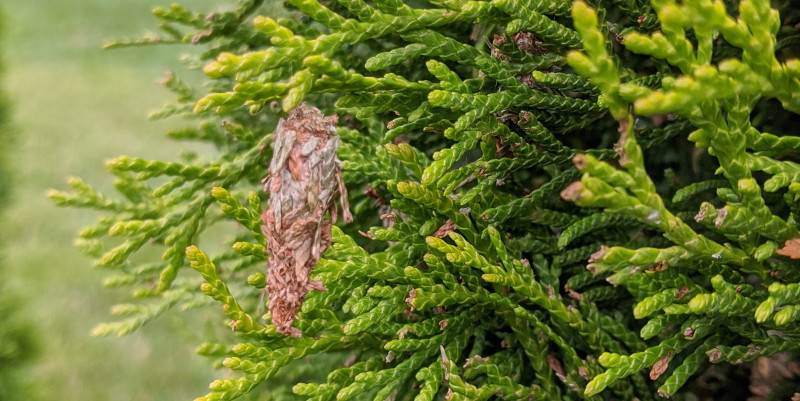
Bagworm bags hanging throughout an infested arborvitae.
Timing makes a big difference with bagworms. The right treatment depends on where the insects are in their life cycle. Dates vary by region, and colder areas may run a few weeks later.
Season
What Bagworms Are Doing
What To Do
Fall through early spring
Eggs overwinter inside the female's bag
Pick off and destroy bags
May to June
Eggs hatch, and tiny caterpillars spin new bags about 1/8 inch long. Some drift to nearby plants on silk threads.
Spray Bt and keep removing any bags you can reach
July to August
Caterpillars and bags grow larger, and damage becomes easy to see
Bt is less effective after mid-July. Use an insecticide labeled for bagworms if needed.
Late August to fall
Caterpillars stop feeding and pupate. Males fly to females to mate, and females lay eggs in their bags.
Sprays no longer help. Hand-pick bags.
What Are Bagworms?
Bagworms are dark brown caterpillars that love to feed on over 128 different plant species. However, arborvitae, red cedar, and juniper are the most common plants that bagworms will eat. The insects are only about an inch long when fully grown. They weave silk bags covered in bits of foliage as they feed on the branches. The bags are only 1 to 2 inches long, but the infestation can be daunting if not treated right away.
The caterpillars carry their bags with them as they feed on different sections of the plant. Adult females are wingless and never leave the bag. The males are black moths that will fly to the silk bag and mate. Each female can lay up to 1,000 eggs inside her bag, which can overrun arborvitae in a hurry if not dealt with promptly.
Each bag holds a single caterpillar, which carries the bag with it as it feeds.
Signs Of Bagworms On Arborvitae
Bagworm damage is easy to miss early in the season because the young caterpillars and their bags are small. Many gardeners do not notice them until late summer, after serious damage has already occurred.
What to look for
Hanging brown bags: Cone-shaped bags dangling from the branches. They are easy to mistake for small pinecones or seed cones.
Browning from the top down: Bare, brown patches that often start near the top of the plant.
Caterpillars poking out of bags: Small dark caterpillars reaching out of the bags to feed in summer.
Thinning foliage: Damage that gets steadily worse from June through August.
Bagworm caterpillars reach out of their bags to feed and pull back inside when disturbed.
What Do Bagworms Do To Arborvitae?
The damage done by these small caterpillars can be significant and can even kill the plant if left untreated. The insects typically start at the top of the tree and work their way down. Each section is defoliated as the caterpillar feeds and leaves behind brown bare foliage and branches.
Bagworm damage on arborvitae is often permanent. Arborvitae cannot regrow foliage on bare branches, so catching an infestation early makes a big difference.
How To Get Rid Of Bagworms On Arborvitae
The best method depends on how many bagworms you have and the time of year. Hand-picking works for light infestations, and sprays work best for larger ones.
1. Pick Off The Bags By Hand
For light infestations, you may be able to just pick the bags off of the tree. Work in sections and try to remove all of them. Each female left behind can produce up to 1,000 eggs, so it is important to not leave any behind.
The bags are attached with tough silk, so snipping them off with hand pruners is often easier than pulling. If you cannot reach the top of the tree, a pole pruner can help you clip off bags on higher branches.
Fall, winter and early spring are the best times to hand-pick, before the eggs hatch in late spring.
Hand-picking is the simplest way to control bagworms on smaller arborvitae.
2. Dispose Of The Bags
Once you pick the bags, be sure to collect them all and dispose of them. Do not leave them on the ground near the plant. Drop them into a bucket of soapy water, or seal them in a bag and put them in the trash.
3. Spray Bacillus Thuringiensis (Bt)
If the infestation is too much to treat manually, you can spray the bacterium Bacillus thuringiensis (Bt) on the plant. It is safe for birds, pets and other animals, but will kill the caterpillars once they eat the treated foliage. Bt can also harm butterfly and moth caterpillars, so spray only the plants that need it. Follow the label instructions, as more than one application may be needed.
Bt works best on young bagworms. June is usually the best month to spray, soon after the eggs hatch and while the caterpillars are still small. The best time of day to treat is in the morning or evening when the worms are feeding.
Even if not all of your arborvitae are infested, it is still a good idea to treat them all at the same time. Young bagworms can drift from plant to plant on silk threads.
4. Use An Insecticide For Larger Caterpillars
If bagworms are not discovered until later in summer, the caterpillars may be too large for Bt to work well. An insecticide labeled for both bagworms and arborvitae can provide control when applied thoroughly to all infested foliage after mid-July. Always read and follow the label directions.
5. Ask Your Local Extension Office
You can also contact your local extension office for area-specific advice on which organic or inorganic options work best in your area, and which pesticides are the most effective on bagworms as well as safe for the environment.
Best timing for Bt: Spray in June, soon after the eggs hatch, while the caterpillars and bags are still small. Bt becomes much less effective after mid-July.
Will Arborvitae Recover From Bagworm Damage?
Unfortunately, it can take a while for arborvitae to recover from bagworm damage. Branches that were only lightly fed on may recover, but sections that are completely brown and bare usually will not grow new foliage.
How to check for live branches
Scratch the bark. Use a fingernail to scrape a small section of bark on a brown branch.
Look for green tissue. If there is some green, the branch may still be viable and add new growth the following year.
Remove dead branches. If the tissue is brown and dry, the branch is dead. It is usually best to cut it off, even if that means cutting out big portions of the arborvitae.
Cut back to live growth. Prune dead branches back to a live branch or to the trunk, since arborvitae will not sprout from bare wood.
When the plant does recover, it happens from growth on the tips of the branches, which will eventually cover up the damage further inside of the plant. Sometimes, this can take several years if the damage was bad enough. Consistent watering and fertilizing in spring help support that new growth.
You may decide to just replace the plant if the damage is severe or makes the plant look uneven in appearance.
Brown Arborvitae: Bagworms Or Something Else?
Not all browning on arborvitae comes from bagworms. If you do not see any bags, one of these other causes may be to blame.
What You See
Likely Cause
What To Do
Hanging bags and chewed, bare foliage, often starting near the top
Bagworms
Remove bags and treat based on the season
Inner foliage turns yellow or brown in fall while outer foliage stays green
Normal seasonal needle drop
No treatment needed. Older interior foliage sheds naturally.
Browning on the windy or sunny side in late winter or early spring
Bagworms are much easier to manage when you catch them before the eggs hatch. A few quick checks each year can keep a small problem from spreading through a hedge.
Inspect in the off-season: Check arborvitae, junipers and red cedars each fall, winter and early spring for hanging bags, and remove any you find.
Check again in June: Look for tiny new bags at the branch tips, since young caterpillars can drift in from nearby infested trees.
Inspect new plants: Look over new evergreens for bags before planting them near existing arborvitae.
Keep plants healthy: Well-watered, well-fed arborvitae handle stress better and fill in faster after damage. See our arborvitae care guide for more.
Frequently Asked Questions About Bagworms On Arborvitae
What do bagworms look like?
Bagworms are easiest to spot by their bags. Look for brown, cone-shaped bags 1 to 2 inches long, made of silk and bits of foliage, hanging from the branches. The caterpillar inside is dark brown and about an inch long when fully grown.
Do bagworms kill arborvitae?
Yes, heavy infestations can kill arborvitae, especially when left untreated. Because arborvitae cannot regrow foliage on bare branches, the damage builds up over time.
When do bagworms hatch?
Bagworm eggs overwinter inside the female's bag and hatch in late spring, usually May to early June depending on your region.
When is the best time to spray for bagworms?
Spray Bt in late spring to early summer, usually June, while the caterpillars are small. Bt is much less effective after mid-July, when an insecticide labeled for bagworms is a better choice.
Can I spray for bagworms in the fall?
No. By late summer the caterpillars stop feeding and seal themselves inside their bags, so sprays will not reach them. Hand-pick the bags in fall, winter or early spring instead.
Do bagworms come back every year?
They can. Any bags left on the plant hold eggs that hatch the following spring, so the population can grow each year if the bags are not removed.
Will brown arborvitae turn green again?
Usually not. Sections that are completely brown and bare rarely regrow foliage. New growth from the surrounding branch tips can fill in the gaps over several years.
Do bagworms only attack arborvitae?
No. Bagworms feed on more than 128 plant species. Arborvitae, juniper, red cedar, spruce and pine are the most commonly damaged, but they also feed on some deciduous trees.
Video: Bagworms On Arborvitae
Sources: "Bagworms on Trees and Shrubs." University of Maryland Extension. extension.umd.edu
Bottom Line
Bagworms can do serious and often permanent damage to arborvitae, but they are manageable when you catch them early. Hand-picking bags from fall through early spring removes next year's eggs before they hatch.
For larger infestations, spray Bt in June while the caterpillars are small, or use a labeled insecticide for older caterpillars after mid-July. After an infestation, scratch-test brown branches, prune out dead wood, and give the plant time to fill back in from the branch tips.
Sources
University of Maryland Extension: Bagworms on Trees and Shrubs
University of Maryland Extension: What's Eating My Tree? Bagworms or Webworms?
Chris Link is the co-owner of Plant Addicts and helps gardeners find the right plants for their yards, homes, and growing conditions. Plant Addicts has helped millions of gardeners shop for plants and learn how to care for them.